When Jide Apata loses Emma Akpan—the only friend who ever understood him—his carefully sheltered world collapses. Grief turns to fury, and the quiet resentment he once held toward his strict father shifts upward toward God Himself.
In the wreckage of rebellion and self‑destruction, Jide searches for meaning, for relief, for any reason to keep living.
Why Me? is the story of a wounded soul wrestling with a God who feels painfully absent.
But is God truly distant… or has Jide been looking in the wrong direction all along?
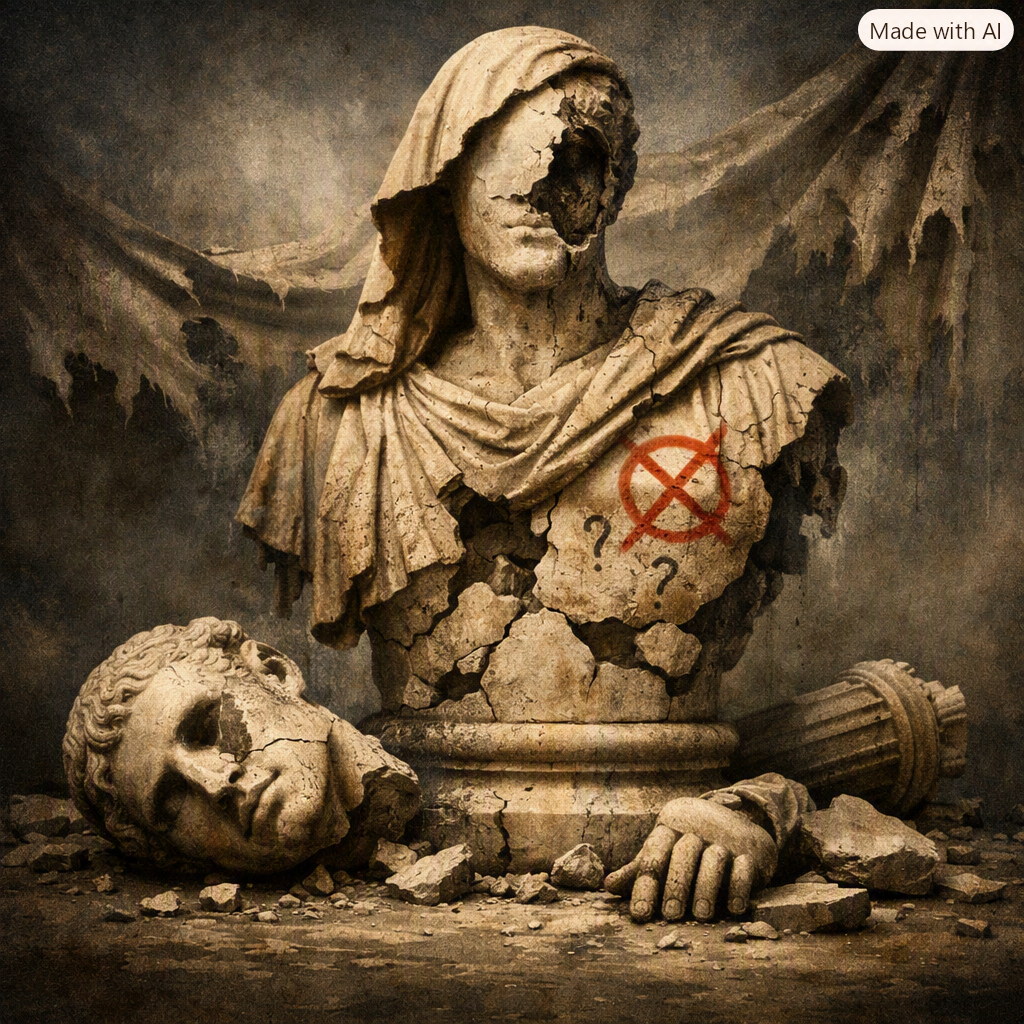
The debates that erupted in 2020 over statues, monuments, and historical memory have not faded—they have simply evolved. What began with the toppling of figures linked to slavery and colonialism has expanded into a broader struggle over who controls the narrative of the past, and by extension, the identity of the present. The term cancel culture still circulates, but its meaning has become even more contested. The question remains: whose culture is actually being cancelled?
The old adage, “History is written by victors,” still explains much of the tension. For centuries, Western accounts have framed “discoveries” by Mungo Park, David Livingstone, Christopher Columbus, and Captain Cook as heroic milestones, despite the presence of indigenous peoples who had lived on those lands for generations. The imbalance of voice persists: the conqueror’s story is amplified; the conquered are footnotes.
But the landscape has shifted. Since 2020, digital platforms have become the new battleground for historical interpretation. Algorithms now determine which narratives gain prominence and which are buried. Viral outrage can elevate a forgotten injustice within hours—or erase nuance just as quickly. The storyteller has changed, but the power struggle remains.
The New Extremes
The polarisation around statues has intensified. On one side are those who insist that removing monuments is an attack on heritage. On the other are those who argue that keeping them is an endorsement of oppression.
Both positions often miss the point: context matters. History should be recorded—not romanticised, sanitised, or weaponised.
Yet societies continue to “hide” certain histories when convenient. There are still no monuments to Hitler, no public grave for Osama bin Laden, and no tolerance for symbols like the swastika, ISIS flags, or KKK insignia. These absences are not seen as “cancelling history,” but as moral clarity. The same logic rarely extends to colonial figures whose legacies are far more complex.
Even in 2026, discussions about the transatlantic slave trade still underplay the role of African intermediaries who captured and sold fellow Africans. This omission persists because it complicates the narrative—yet history is rarely tidy.
The Power of Representation
The question of how we portray historical figures is more urgent than ever. No individual is flawless, yet monuments often present them as such. A man on horseback may symbolise triumph to some, but domination to others.
In recent years, artists and historians have begun experimenting with dual‑narrative monuments—installations that acknowledge both achievement and harm. These attempts reflect a growing recognition that history is not a choice between celebration and erasure, but an invitation to wrestle with complexity.
The Digital Storyteller
Since 2020, the influence of media, film, and online culture has only grown. Stereotypes continue to be reinforced—sometimes subtly, sometimes blatantly. The black man as threat. The immigrant as burden. Africa as perpetual crisis. Middle America as monolithic and intolerant.
These narratives shape public perception far more than any statue. They influence policy, policing, and personal interactions. They also determine which histories are amplified and which are forgotten.
It is telling that many still do not know that African Americans once made up roughly a quarter of cowboys in the 1800s, or that some of the world’s earliest universities were in Africa. Or that Christianity reached Africa centuries before it reached much of Europe. These facts challenge the dominant cultural script—and that is precisely why they matter.
Learning From the Past Without Distorting It
George Santayana’s warning—“Those who cannot learn from history are doomed to repeat it”—feels even more relevant in 2026. But learning requires accuracy. If the history we preserve is skewed, incomplete, or filtered through the lens of power, then its lessons are compromised.
Statues alone cannot correct historical wrongs. But neither should they reinforce a single, dominant narrative. The goal is not to erase history, but to illuminate it—fully, honestly, and without fear.
So, Whose Culture Is Being Cancelled?
The struggle over monuments is ultimately a struggle over memory, identity, and influence. It is not simply about the past, but about who gets to define the future.
The real danger is not that history will be cancelled, but that it will continue to be curated by the same narrow perspectives that shaped it for centuries.
And so the question remains—perhaps more urgently than before: Whose culture is truly being cancelled?
“Your eyes saw my unformed body; all the days ordained for me were written in your book before one of them came to be.” – Psalm 139:16 (NIV)
Life stretches before us like a long, unfolding horizon—from the quiet pulse of a beating heart to the deep stirrings of a searching soul.
We survive, we wonder, we ache, we hope. And in all of it, we reach for meaning.
Some call life a mere accident of biology. Others see it as a journey shaped by purpose, values, and the whisper of something greater.
But beneath every view lies the same longing: What does it all mean, and who are we meant to become?
Life in Pages begins with a simple conviction: that the One who breathed life into us is also the One who gives it meaning. He sees the story from the first word to the last, and He invites us to read it with Him.
History is crowded with voices—theories, philosophies, religions, each claiming to hold the truth. But truth is not a shifting shadow cast by our feelings or perspectives. Truth is a steady light, a reality that stands whether or not we acknowledge it.
And this truth is not confined to data or logic. It is woven into our tears and our laughter, our dreams and our disappointments, the quiet places where science cannot measure but the soul knows something holy is near.
If God is the Author of life, then Scripture is the manual He has given—not to restrict us, but to teach us how to live fully, wisely, and in step with His heart.
So, Paul’s words echo gently over us: “Be very careful, then, how you live—not as unwise but as wise, making the most of every opportunity” (Ephesians 5:15-16).
And Proverbs reminds us that wisdom begins where reverence begins—in the fear of the Lord.
This devotional journey is an invitation: to slow down, to listen, to turn the pages of life with the One who wrote them.
May each page draw you closer to the God who knows you, calls you, and walks with you still.
Reflection
Where do I currently look for meaning in my life — in achievement, relationships, or in the One who authored me?
How do I respond to the idea that truth is not shaped by my feelings but revealed by God’s steady light?
What would it look like to “turn the pages of life” with God — to live each day aware of His presence and guidance?
Prayer
Lord, Author of my life, thank You for writing a story far bigger than I can see. As I walk through the pages of my days, teach me to seek Your wisdom, listen for Your voice, and trust the truth that comes from You alone. Draw my heart toward Your steady light and help me live each moment in step with Your purpose. May my life reflect the One who formed me, knows me, and walks with me still. In Jesus Name, Amen.
Sed ut perspiciatis unde omnis iste natus error sit voluptatem accusantium doloremque laudantium, totam rem aperiam, eaque ipsa quae ab illo inventore veritatis et quasi architecto beatae vitae dicta sunt explicabo. Nemo enim ipsam voluptatem quia voluptas sit aspernatur aut odit aut fugit, sed quia consequuntur magni dolores eos qui ratione voluptatem sequi nesciunt.
Neque porro quisquam est, qui dolorem ipsum quia dolor sit amet, consectetur, adipisci velit, sed quia non numquam eius modi tempora incidunt ut labore et dolore magnam aliquam quaerat voluptatem. Ut enim ad minima veniam, quis nostrum exercitationem ullam corporis suscipit laboriosam, nisi ut aliquid ex ea commodi consequatur? Quis autem vel eum iure reprehenderit qui in ea voluptate velit esse quam nihil molestiae consequatur, vel illum qui dolorem eum fugiat quo voluptas nulla pariatur?
Sed ut perspiciatis unde omnis iste natus error sit voluptatem accusantium doloremque laudantium, totam rem aperiam, eaque ipsa quae ab illo inventore veritatis